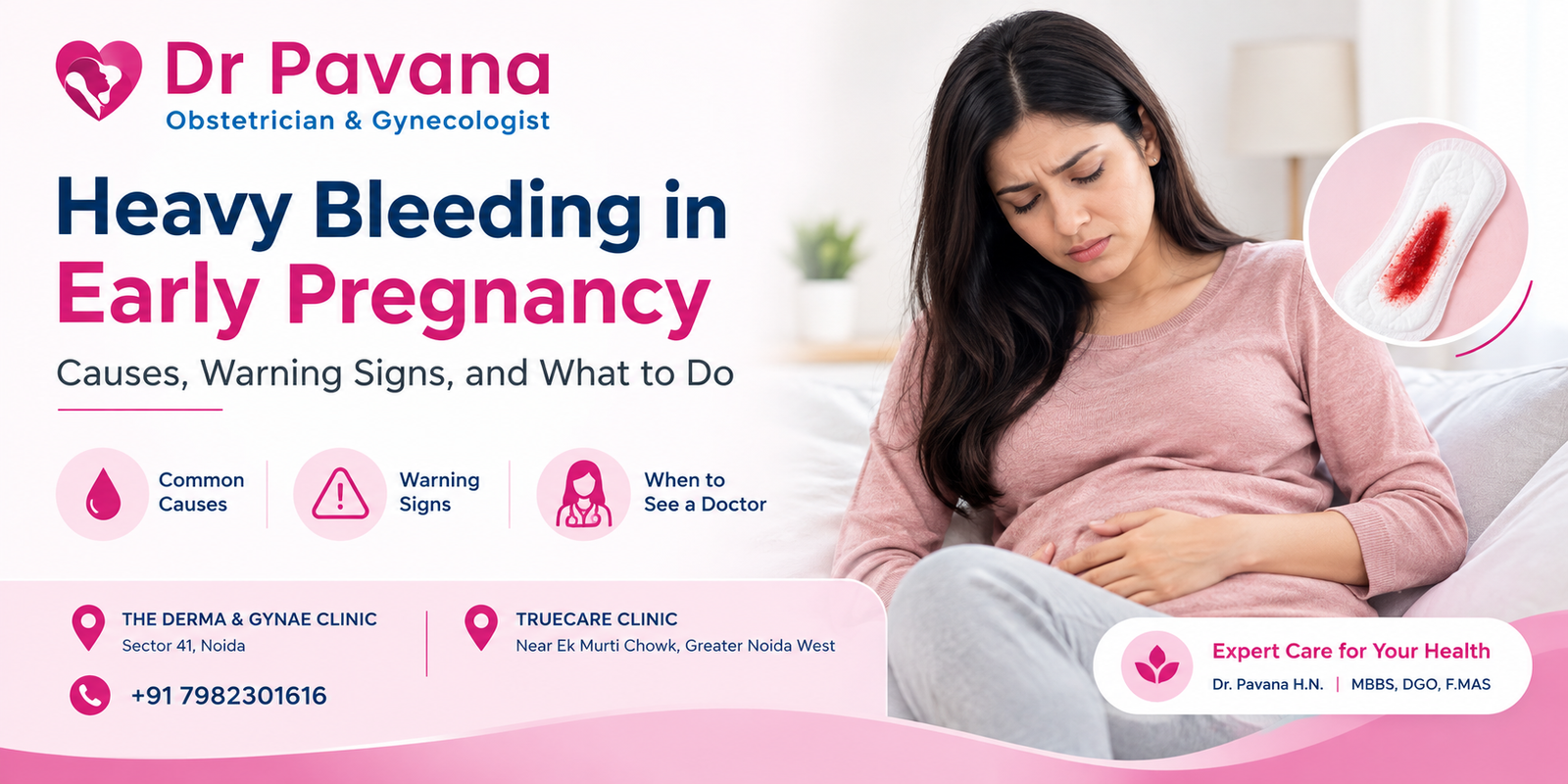
Bleeding during early pregnancy is one of the most frightening experiences a pregnant woman can have. While light spotting is relatively common and often harmless, heavy bleeding in early pregnancy is a different matter it requires prompt medical attention. If you are experiencing heavy bleeding in pregnancy and you are in Noida or Greater Noida West, contact Dr. Pavana H.N. at The Derma & Gynae Clinic, Sector 41 (call 7982301616) or TrueCare Clinic, near Ek Murti Chowk (call +91 9582525020). Do not wait to see if the bleeding resolves on its own.
What is the difference between spotting and heavy bleeding in early pregnancy?
Not all pregnancy bleeding is the same. Understanding the difference helps you decide how quickly to seek care.
Spotting in early pregnancy means seeing a small amount of blood on your underwear, toilet paper, or a panty liner. It may appear pink, brown, or light red. Spotting does not typically require a sanitary pad and may only be noticeable when wiping. Light spotting can have several causes that are not immediately serious.
Heavy bleeding in early pregnancy resembles a menstrual period or is heavier, requiring a sanitary pad to manage and may occur with abdominal cramps, lower back pain, or the passage of blood clots or tissue. Heavy bleeding should never be ignored.
The comparison below gives a general guide. However, any bleeding during pregnancy should be reported to your gynaecologist, regardless of amount.
Spotting: a few drops or spots of blood, appearing pink or brown, often only noticeable when wiping, may have several harmless causes, little or no pain.
Heavy bleeding: flow that requires a sanitary pad, often bright red or dark red, may soak through a pad, may occur with cramps or severe pain, requires prompt medical evaluation.
How common is early pregnancy bleeding in India?
Research published in Indian medical journals shows that vaginal bleeding in the first trimester occurs in 16 to 25 percent of pregnancies. Of women who experience first-trimester bleeding, approximately half will have a miscarriage, while the other half will go on to have a continuing pregnancy. However, women with first-trimester bleeding are at higher risk of later complications including preterm labour, placenta praevia, and antepartum haemorrhage, which is why every episode of bleeding in pregnancy requires proper evaluation, not a wait-and-see approach.
Heavy bleeding specifically carries a more serious prognosis. A 2025 Indian study published in the International Journal of Reproduction, Contraception, Obstetrics and Gynaecology found that in all cases where first-trimester bleeding was classified as heavy, the pregnancy had a non-viable outcome. This reinforces the importance of urgent assessment when bleeding is significant.
Is spotting during early pregnancy normal?
Light spotting can occur for several reasons in early pregnancy, and not all of them are serious. Possible causes include implantation-related bleeding, hormonal changes that make the cervix more sensitive, light bleeding after sexual intercourse, bleeding after a pelvic examination, minor cervical or vaginal infections, and a small subchorionic haematoma.
No amount of bleeding is entirely normal during pregnancy. Contact your gynaecologist so they can properly assess the cause. Never assume that spotting is harmless without a medical evaluation, particularly if it becomes heavier, is accompanied by pain, or occurs alongside other symptoms.
What causes heavy bleeding in early pregnancy?
Heavy bleeding in early pregnancy has several possible causes. Some are manageable with close monitoring, while others require urgent medical treatment.
Miscarriage
Miscarriage, the loss of pregnancy before 20 weeks, is one of the most common causes of heavy bleeding in the first trimester. Bleeding may begin lightly and become heavier over time, and may be accompanied by the passage of blood clots or pregnancy tissue. Other symptoms can include strong abdominal or pelvic cramps, lower back pain, and a decrease in pregnancy symptoms such as nausea or breast tenderness.
It is important to note that heavy bleeding does not always mean a miscarriage is occurring or has occurred. An ultrasound scan and blood tests are needed to determine what is happening. It is also important to know that most early miscarriages are not caused by any action or omission by the woman. In the majority of cases, miscarriage occurs because the pregnancy was not developing normally, most often due to chromosomal differences.
Ectopic pregnancy
An ectopic pregnancy occurs when a fertilised egg implants outside the main cavity of the uterus, most commonly in a fallopian tube. This is a medical emergency. The fallopian tube cannot expand to accommodate a growing pregnancy, and if left untreated, it can rupture and cause life-threatening internal bleeding.
Go to the emergency department of the nearest hospital immediately if bleeding in early pregnancy is accompanied by any of the following: severe or worsening abdominal pain, pain predominantly on one side of the abdomen, shoulder-tip pain (caused by blood irritating the diaphragm), dizziness or fainting, extreme weakness, or a feeling of being very unwell. Ectopic pregnancy is rare but life-threatening and requires emergency treatment without delay.
Subchorionic haematoma
A subchorionic haematoma occurs when blood collects between the pregnancy sac and the wall of the uterus. It is one of the more common ultrasound findings in women presenting with first-trimester bleeding in India, and it can cause anything from light spotting to more noticeable bleeding. Small subchorionic haematomas often resolve without intervention. Larger ones may require closer ultrasound monitoring throughout the pregnancy, as they are associated with a slightly higher risk of miscarriage, preterm labour, and placental complications if they do not resolve.
If you have been told you have a subchorionic haematoma, Dr. Pavana H.N. will advise on the appropriate follow-up schedule based on the haematoma size and how your pregnancy is progressing.
Cervical changes
Pregnancy increases blood flow to the cervix and makes it more sensitive. This can cause light bleeding, particularly after sexual intercourse or a vaginal examination. Cervical irritation typically causes spotting rather than heavy bleeding. Any persistent or recurrent bleeding from this cause should still be evaluated to rule out cervical polyps or cervicitis.
Infections
Some vaginal or cervical infections, including sexually transmitted infections and bacterial vaginosis, can cause bleeding or spotting. If an infection is suspected, appropriate testing and treatment will be recommended during your consultation.
No identifiable cause
In some pregnancies, an exact cause of early bleeding cannot be found even after thorough assessment. If the ultrasound shows a viable pregnancy and all other assessments are reassuring, many such pregnancies continue normally. Close monitoring, including repeat ultrasound scans and follow-up appointments, is still recommended.
How much bleeding is too much in early pregnancy?
There is no single volume of blood that can determine whether a pregnancy is safe. However, the following situations require urgent medical attention and should not be managed at home.
You are soaking through approximately two or more sanitary pads in one hour. You are passing large blood clots or what appears to be pregnancy tissue. You have significant abdominal pain alongside the bleeding. You feel dizzy, faint, extremely weak, or very unwell. You have shoulder-tip pain together with abdominal pain and bleeding.
If you experience any of these, do not wait for the bleeding to slow down. Go to the emergency department of the nearest hospital without delay.
What should you do if you have heavy bleeding in early pregnancy?
Stay as calm as possible and take the following steps.
Use a sanitary pad rather than a tampon so you can monitor the amount and colour of the blood. Note when the bleeding started, how heavy it is, and what colour it is whether pink, brown, or bright red. Pay attention to whether you are also passing clots or tissue, and note any associated pain, cramping, dizziness, or weakness. Call your gynaecologist without delay. In Noida and Greater Noida West, Dr. Pavana H.N. can be reached on 7982301616 (Sector 41) or +91 9582525020 (Ek Murti Chowk). If the bleeding is very heavy or you have severe pain, dizziness, fainting, or shoulder-tip pain, go to the emergency department of the nearest hospital rather than waiting for a clinic appointment. If pregnancy tissue passes, ask your gynaecologist whether it should be kept for examination.
How is early pregnancy bleeding diagnosed?
Your gynaecologist will assess the cause based on your symptoms, the stage of your pregnancy, a physical examination, and test results. Tests that may be recommended include a pelvic examination, a quantitative hCG blood test to measure pregnancy hormone levels and assess whether they are rising normally, an ultrasound scan to determine the location of the pregnancy and assess the fetal heartbeat, blood group and Rh factor testing, and additional tests if an infection or other condition is suspected.
The ultrasound scan is the most important investigation. It can confirm whether the pregnancy is located inside the uterus, check for a fetal heartbeat, assess the pregnancy for signs of miscarriage, identify a subchorionic haematoma, and rule out an ectopic pregnancy in most cases.
Does bleeding in early pregnancy always mean miscarriage?
No. Bleeding in early pregnancy does not always indicate a miscarriage. Some women experience spotting or light bleeding and go on to have a completely healthy pregnancy and delivery. However, bleeding can also be an early warning sign of miscarriage or ectopic pregnancy and the only way to determine the cause is through an ultrasound and appropriate blood tests.
Do not attempt to judge the cause of pregnancy bleeding based on the amount, colour, or associated symptoms alone. Seek a prompt gynaecological assessment.
When should you go to the emergency room?
Go to the emergency department immediately without waiting for a clinic appointment if you experience any of the following during early pregnancy.
Bleeding that soaks two or more sanitary pads within one hour. Severe or rapidly worsening abdominal pain. Pain predominantly on one side of the abdomen. Shoulder-tip pain. Dizziness or fainting. Extreme weakness or feeling very unwell. Passage of large blood clots or significant tissue. Any combination of heavy bleeding with the symptoms listed above.
These symptoms may indicate a serious pregnancy complication, including a ruptured ectopic pregnancy, that requires immediate hospital treatment.
Consult Dr. Pavana H.N. for pregnancy bleeding in Noida and Greater Noida West
If you are experiencing any bleeding during pregnancy and you are in Noida or Greater Noida West, Dr. Pavana H.N. (MBBS, DGO, F.MAS), Consultant Gynaecologist and Obstetrician, is available at two clinic locations.
The Derma & Gynae Clinic, Block-A, Sector 41, Noida. Phone: 7982301616. Open Monday to Saturday, 12:00 PM to 3:00 PM. Thursday also open 6:00 PM to 8:00 PM.
TrueCare Clinic, Saviour Green Arch Market, above Apollo Pharmacy, near Ek Murti Chowk, Greater Noida West. Phone: +91 9582525020. Open Monday to Saturday, 6:00 PM to 9:00 PM. Sunday 12:00 PM to 1:30 PM.
Dr. Pavana H.N. will assess your symptoms, arrange appropriate investigations, and advise on the safest management for your specific situation. Women from Sectors 39, 40, 41, 42, 44, 47, and 50 in Noida, and from Gaur City, Amrapali Dream Valley, Cherry County, Fusion Homes, and all of Greater Noida West, are welcome at either clinic. Early assessment provides clarity and allows timely care when it matters most.
Frequently Asked Questions — Heavy Bleeding in Early Pregnancy
1: Is spotting in early pregnancy normal?
Light spotting can occur for several reasons in early pregnancy and is not always a sign of a serious problem. Possible causes include implantation-related bleeding, hormonal changes making the cervix more sensitive, light bleeding after intercourse, bleeding after a pelvic examination, minor cervical infections, or a small subchorionic haematoma. No bleeding during pregnancy should be assumed to be harmless without assessment. Contact your gynaecologist if you notice any bleeding, particularly if it becomes heavier or is associated with pain.
2: Does heavy bleeding always mean miscarriage?
No. Heavy bleeding in early pregnancy does not always mean a miscarriage is occurring. However, it is a warning sign that requires prompt assessment — including an ultrasound scan and blood tests to identify the cause. Some women with early pregnancy bleeding go on to have healthy pregnancies, while others may be experiencing a miscarriage or another complication such as an ectopic pregnancy. A gynaecological evaluation is the only reliable way to determine what is happening.
3: What are the symptoms of an ectopic pregnancy?
Ectopic pregnancy bleeding is often accompanied by severe or worsening one-sided abdominal pain, shoulder-tip pain caused by blood irritating the diaphragm, dizziness, fainting, or extreme weakness. The external bleeding may not always be heavy, as the primary bleeding can be internal. Ectopic pregnancy is a medical emergency. If you have these symptoms during early pregnancy, go to the emergency department of the nearest hospital immediately do not wait for a clinic appointment.
4: How much bleeding is too much in early pregnancy?
Seek urgent hospital care if you are soaking through two or more sanitary pads in one hour, passing large blood clots or pregnancy tissue, experiencing severe abdominal pain alongside the bleeding, feeling dizzy or faint, or have shoulder-tip pain with abdominal bleeding. Any of these signs indicate the need for emergency medical attention without delay.
5: What tests are done for bleeding in early pregnancy?
Your gynaecologist will typically recommend a pelvic examination, a quantitative hCG blood test to assess pregnancy hormone levels, an ultrasound scan to check the location of the pregnancy and fetal heartbeat, blood group and Rh factor testing, and additional investigations if an infection is suspected. The ultrasound scan is the most important investigation and can identify the cause in many cases.
6: Where can I see a gynaecologist in Noida for early pregnancy bleeding?
Dr. Pavana H.N. (MBBS, DGO, F.MAS) sees patients for pregnancy-related concerns at The Derma & Gynae Clinic, Block-A, Sector 41, Noida call 7982301616 and TrueCare Clinic, Saviour Green Arch Market, above Apollo Pharmacy, near Ek Murti Chowk, Greater Noida West call +91 9582525020. If your bleeding is very heavy, or you have severe pain, dizziness, or fainting, go to the emergency department of the nearest hospital immediately rather than waiting for a clinic slot.
7: What is a subchorionic haematoma in early pregnancy?
A subchorionic haematoma is a collection of blood between the pregnancy sac and the uterine wall. It is a relatively common finding on first-trimester ultrasound in women presenting with early pregnancy bleeding. Small haematomas often resolve without treatment. Larger ones may require closer monitoring, as they are associated with a slightly higher risk of miscarriage, preterm labour, and placental complications if they do not resolve. Dr. Pavana H.N. will advise on the appropriate follow-up schedule based on haematoma size and individual pregnancy progress.
8: Can I prevent a miscarriage if I am bleeding heavily in early pregnancy?
In most cases of early miscarriage, the pregnancy is not developing normally usually due to chromosomal differences and the miscarriage cannot be prevented. Most early miscarriages are not caused by any action or omission by the woman. Resting, avoiding intercourse, or reducing activity does not prevent a miscarriage that is already underway. What matters most is prompt assessment to confirm the situation and to rule out conditions such as ectopic pregnancy that require immediate treatment. Call Dr. Pavana H.N. on 7982301616 (Sector 41) or +91 9582525020 (Ek Murti Chowk).
Recent Blogs



Categories

Dedicated to compassionate, expert women’s healthcare, we support every stage of life with personalized gynecological and obstetric services.
Quick Links
Get In Touch
Clinic 1- The Derma & Gynae Clinic
A-59, Block-A Sector-41, Noida
(Near Sector-41, Market)
Contact No.: 7982301616
Clinic 2- Truecare Clinic
UGF -11 Saviour Green Arch Market Near Ek Murti Chowk, Noida Extention
Contact No.: 9582525020
All Rights Reserved.